
Why Most UK Small Businesses Waste Money on Digital Marketing — And What Actually Works
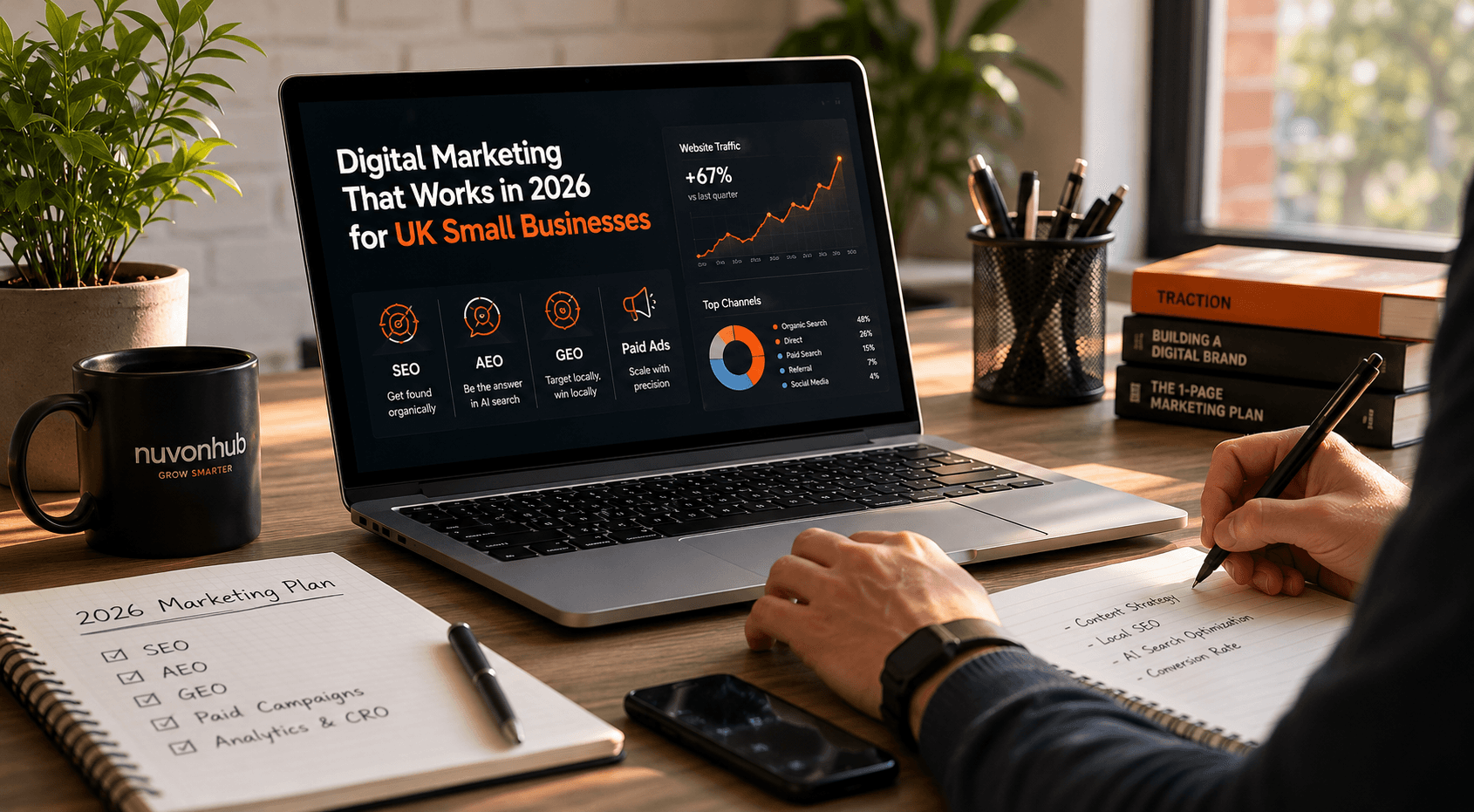
Most small businesses in the UK approach digital marketing the same way. They spend money on something — a Facebook ad, a boosted post, a Google campaign — wait a few weeks, see no results, and conclude that digital marketing does not work for them.
It is not that digital marketing does not work. It is that they are treating it as a one-off spend instead of a system. And systems need to be built before they generate returns.
“The businesses getting consistent inbound leads in 2026 are not spending more. They are spending smarter — on systems that compound rather than campaigns that expire.”
The three layers of digital marketing in 2026
Digital marketing used to mean Google Ads and Facebook. In 2026, the landscape has three distinct layers — and most small businesses are only operating on one of them.
Layer 1 — SEO (Search Engine Optimisation)
This is what most people know. You create pages and content that rank on Google when someone searches for your product or service. It takes time — typically 3 to 6 months before you see meaningful results — but once it works, it compounds. Every month that passes, the organic traffic grows without additional spend.
The mistake most small businesses make with SEO is treating it as a one-time task. They pay someone to “do SEO” for a month, then wonder why nothing happened. SEO is infrastructure. It requires consistent, structured effort over time.
- Technical SEO — site speed, crawlability, structured data
- On-page SEO — keyword-optimised titles, headings, and content
- Content — regular, useful posts that answer real questions
- Local SEO — Google Business Profile, local citations, reviews
Layer 2 — AEO (Answer Engine Optimisation)
This is newer and most small businesses have never heard of it. AEO is about appearing in AI-generated search answers — ChatGPT, Perplexity, Google AI Overviews, and Bing Copilot.
When someone asks an AI search engine “best digital infrastructure company in Watford” or “how to automate wholesale orders UK” — you want your business to be cited in the answer. AEO is how you get there.
It requires structured FAQ content, clean Schema markup, and clear authoritative answers to the questions your customers are actually asking. The businesses investing in AEO now are building a significant advantage over the next two years.
Layer 3 — GEO (Generative Engine Optimisation)
GEO is about getting your business cited when AI systems generate responses about your industry, your location, or your service category. It requires specificity — named locations, named clients, specific numbers, and clear positioning.
Generic content never gets cited by AI. Specific, authoritative, locally relevant content does.
What the data says about UK SME digital marketing
The real reason campaigns fail
The most common reason digital marketing campaigns fail for small businesses is not the platform, the budget, or the targeting. It is the destination.
You spend money sending people to a website that was not built to convert. The ad works — people click. The landing page does not — people leave. The money is wasted.
Before any paid campaign makes sense, the website must be doing its job. That means a clear value proposition above the fold, a specific call to action, fast load times, and a mobile experience that does not frustrate visitors.
Most small business websites were built by someone who focused on how it looks. Not on what it needs to do. The result is a brochure — not a sales system.
What a working digital marketing system looks like
The businesses generating consistent inbound leads in the UK in 2026 have one thing in common — their marketing is connected. Every piece points at the same goal and feeds the same system.
- Website built to convert — fast, clear, with one obvious action per page
- Technical SEO infrastructure — so Google can find and index every page
- AEO content — FAQ schema, structured answers, clear positioning
- GEO signals — named location, named clients, specific results
- Google Business Profile — optimised and active
- Paid campaigns — only once organic is working
- Email sequences — for leads who are not ready to buy yet
- Monthly reporting — against real outcomes, not impressions
None of these work in isolation. All of them together create a system that generates leads without you having to manually push it every month.
Where to start if you are a UK small business
If you are starting from zero, the priority order is simple.
First — set up your Google Business Profile if you have not already. It is free and takes ten minutes. It immediately improves your local visibility on Google Search and Maps.
Second — fix your website. Not the design. The structure. Make sure each page has one clear purpose, one call to action, and loads in under two seconds on mobile.
Third — start creating content. One piece per week targeting a real search term your customers use. Not generic industry news — specific, useful answers to specific questions.
Fourth — once organic is working, add paid campaigns to amplify what is already converting. Not before.
This sequence matters. Skipping to paid without fixing the foundation is how businesses burn through budget with nothing to show for it.
Digital marketing is not complicated. It is consistent, structured work applied to the right foundations in the right order. The businesses winning are not smarter or better funded. They are just more systematic.
Want a marketing system that actually generates leads?
Book a strategy call. We will audit your current digital presence and show you exactly what needs to change.
Book a Free Strategy Call →